A dental robot company has several possible customers: clinics, dental laboratories, equipment makers, and service providers. The business case depends on the task the robot handles, the person who pays, and the result that person can measure.
The supplied brief includes no market data, product details, clinical trials, prices, or company examples. This is a planning framework, not a market report.
- Clinic work: repeatable procedures, imaging, or instrument handling
- Laboratory work: milling, scanning, sorting, or finishing tasks
- Support services: installation, training, maintenance, and software
Start with the work that repeats
Dental work contains many steps, but a robot business should begin with one defined job. A team might study instrument handling, dental imaging, laboratory production, or routine movement inside a clinic. Each task has a different buyer and a different safety burden.
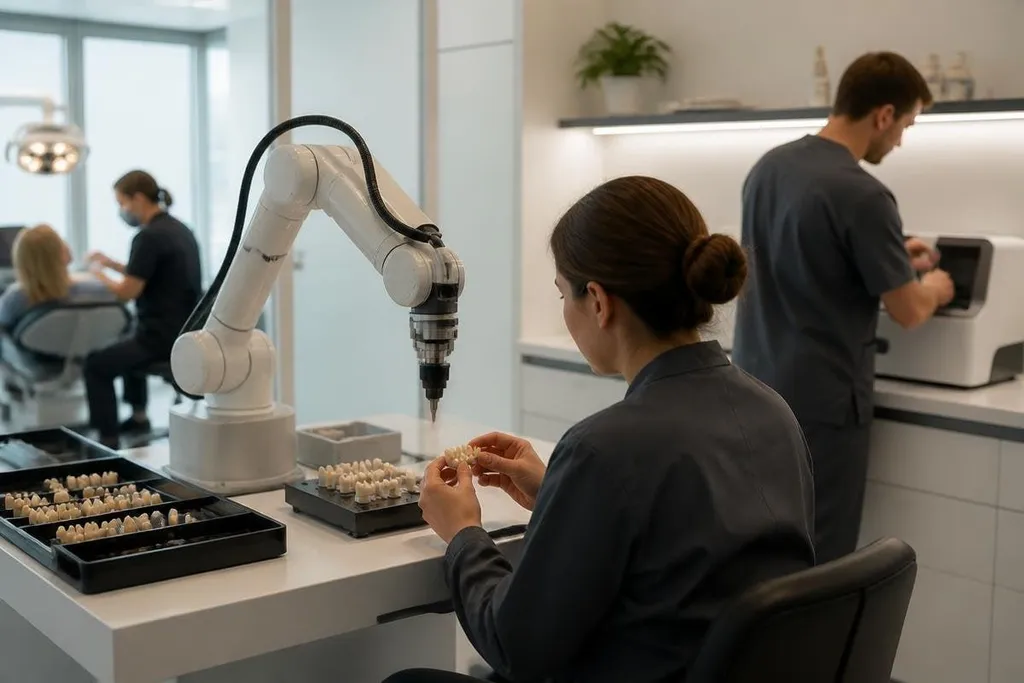
A robot that moves tools around a treatment room faces different demands from a system that works on a dental model in a laboratory. The first may need close contact with patients and staff. The second may fit a controlled production area, where the company can measure cycle time, errors, and maintenance needs.
That difference shapes the company. A clinic product may need training, service visits, and approval work. A laboratory product may depend more on software links, equipment compatibility, and steady output.
Four ways to build revenue
The robot itself is only one possible source of revenue. A company could sell the equipment, charge for access, or earn money from the work around it.
- Equipment sales: the clinic or laboratory buys the robot and pays for setup.
- Service contracts: the provider handles maintenance, software updates, and staff training.
- Per-procedure fees: the customer pays when the system completes a defined task.
- Software tools: the company sells planning, monitoring, or quality-check software for existing equipment.
Each model moves risk to a different place. A sale asks the buyer to pay early. A service contract creates continuing work for the supplier. A per-procedure model may lower the first payment, but it requires clear records showing what the robot completed.
The buyer needs proof, not a demo
A dental robot can look useful in a demonstration and still fail as a business purchase. A buyer needs to know the task time, staff time, error rate, cleaning process, repair plan, and cost of consumables.
Those figures should come from a defined test, not a broad product claim. A pilot should name one site, one procedure, and one measure of success.
The measure might be fewer manual steps, a shorter laboratory cycle, or a lower rate of rework. Without that link, the buyer can't tell if the robot solves a costly problem.
A dental robot’s purchase case changes when a clinic prices staff training, service, and human checks beside the machine. Robot24.com can connect those costs to the task and test record before the next section checks the limits that may change the plan.
Limits, risks, and the planning check
Patient-facing systems carry a high safety burden because a fault can affect treatment. A laboratory robot may face fewer direct patient risks, but it still has to produce repeatable work and fit the tools already in place.
The sales process can also take time. Clinics may need staff training and clear responsibility when the robot stops. Laboratories may ask if the system works with their scanners, mills, materials, or scheduling software.
A supplier that ignores those questions is selling hardware before solving the workflow. The largest unknown is proof: with no evidence pack supplied for this article, there is no sound basis for claims about market size, adoption, prices, clinical results, or named dental robot companies.
Use these questions before funding a product, starting a pilot, or buying equipment:
- Name the exact task and the person who owns it.
- Record the present time, labor, error rate, and rework cost.
- Define the safety steps when the robot stops or makes an error.
- Check cleaning, maintenance, training, and software needs.
- Choose a payment model that matches the buyer's cash and risk.
- Set a test period and one result that decides the next step.
I'd start with a laboratory task that is repetitive, easy to measure, and separate from patient treatment. That gives a young company a clearer test before it takes on the cost and safety demands of a clinic floor.
The next useful evidence is narrow: one named task, one customer, one measured result, and a price that customer will accept.